A coffee with: Manuel Molina
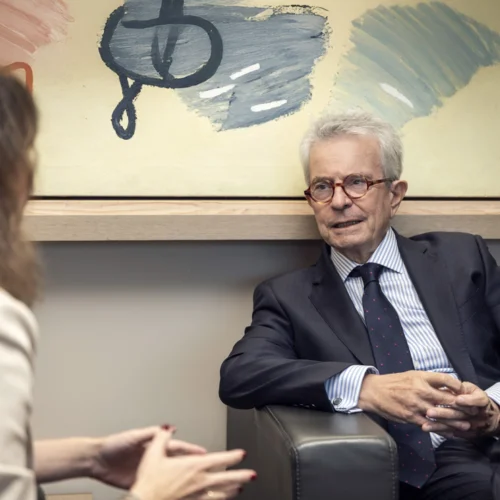
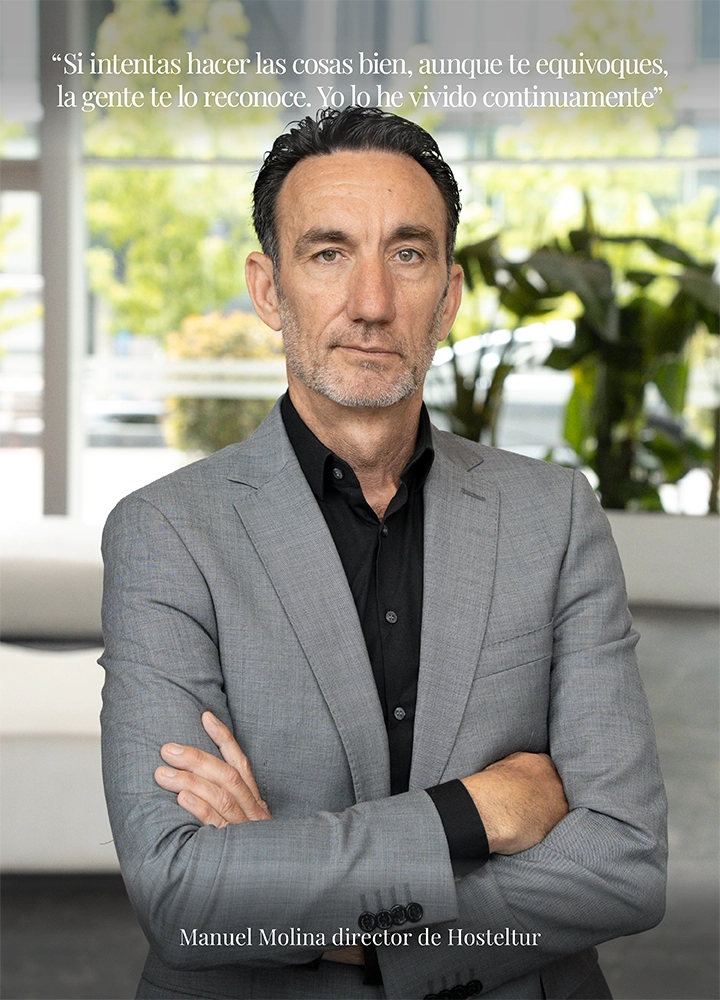
Manuel Molina, Director of Hosteltur
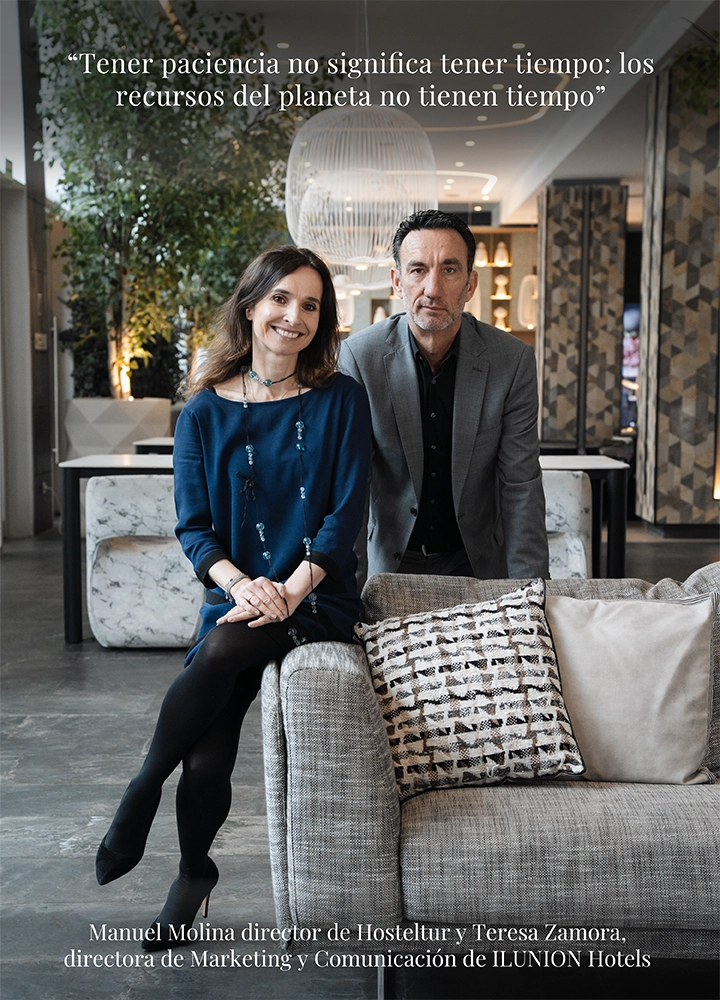
Interview with Manuel Molina, by Teresa Zamora.
May 13, 2026
Before talking about Hosteltur, we would like to get to know you. Who is Manuel Molina?
At 55 years old and with some perspective now, I consider myself a very fortunate person. I have been very lucky throughout my life, and I believe that even bad experiences have left me with more good things than bad.
I have been lucky enough to be surrounded by good people. My family, my wife, my children, and my friends… that is what I am most proud of, and I don’t just say it here; I tell them, especially my children, many times. And then there is my partner Carlos, which might surprise many people, but we have been together since we were 13, since high school. He is a tremendously generous person and also the one who knows me most and best. As 50% partners, I have always had the more high-profile, more visible role, and that is something I always acknowledge… because the truth is that the greatest merit for being where we are is his.
All of that, perhaps out of gratitude, has led me to try to do things right, which I believe is what has worked best for me in life. If you try, it always comes back to you. And when it doesn’t, you are left with the peace of mind of having done it with good intentions.
What inheritance did your father, the founder of Hosteltur, leave you?
Neither my father nor I are journalists by training, so he didn’t pass down formal journalistic values. What he left us was a way of understanding things that I understand better and better every day.
I would highlight two things. First, his enormous capacity for work: no one in our company has been able to match it. Second, a courage that came from ignorance. My father firmly believed that he could achieve whatever he set his mind to. I am more prudent, but that footprint and that courage he left in us is the reason why we remain a company, fundamentally, of people.
Hosteltur was born in the 90s as a print magazine. What was the biggest challenge of that entire transformation without losing the original spirit?
Our birth was the result of ignorance, so I cannot say that such naivety continues to guide us; quite the opposite.
In fact, from the beginning, our growth has always been very measured, fundamentally following two premises.
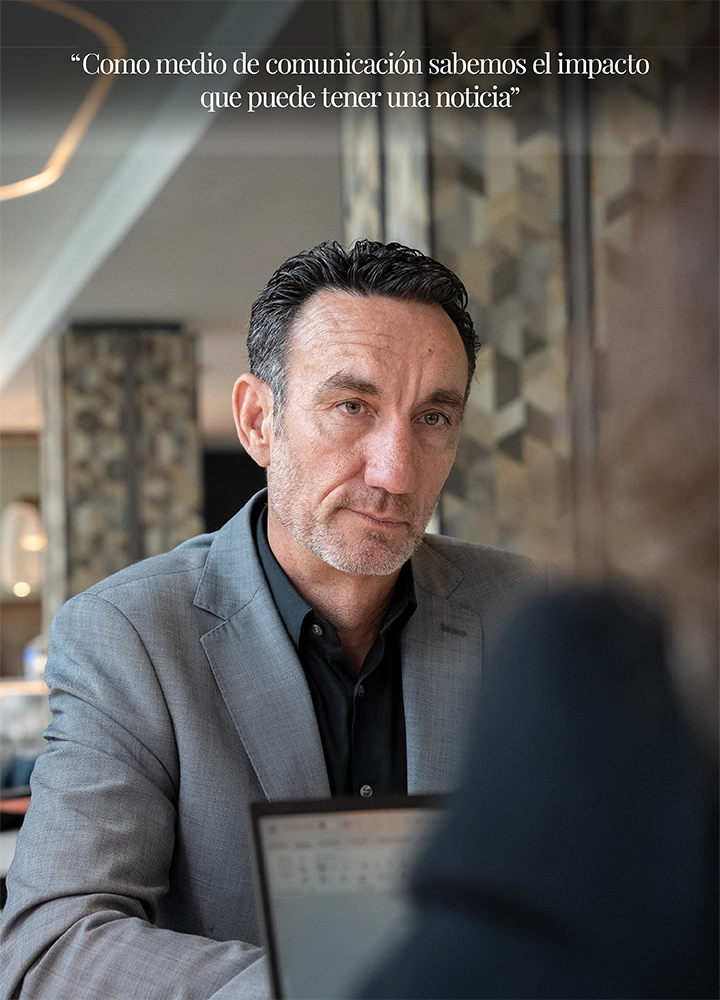
The first is responsibility: as a media outlet, we are aware of the impact a news story can have. The second is making small mistakes. We have tried many things—some have worked and others haven’t—but the ones that didn’t work couldn’t drag us down, because we do not have the capacity to survive a major mistake.
What was the hardest moment?
Until 2020, our most complicated moments had always been the early years: financial difficulties, positioning, and building contacts.
But then the pandemic hit and everything faded to black. We lost practically all our income at the moment when we had our largest workforce. We made a decision: to go down fighting. We threw ourselves entirely into the sector because what was needed most at that moment was information. We did not reduce our staff at any point and we maintained all our commitments to our advertisers, even when 99% of them had to stop investing—which we understood perfectly.
That, once again, strengthened us and, just as the tourism sector emerged stronger from the pandemic, Hosteltur also emerged stronger.
What are the major risks facing the tourism sector today?
Continuing from the previous reflection, it has been proven that everything that could have damaged tourism from the outside has ultimately ended up consolidating it further. Every time there has been a crisis, tourism has emerged stronger, because those crises have highlighted people’s desire to live—and there is no better way to live than by traveling.
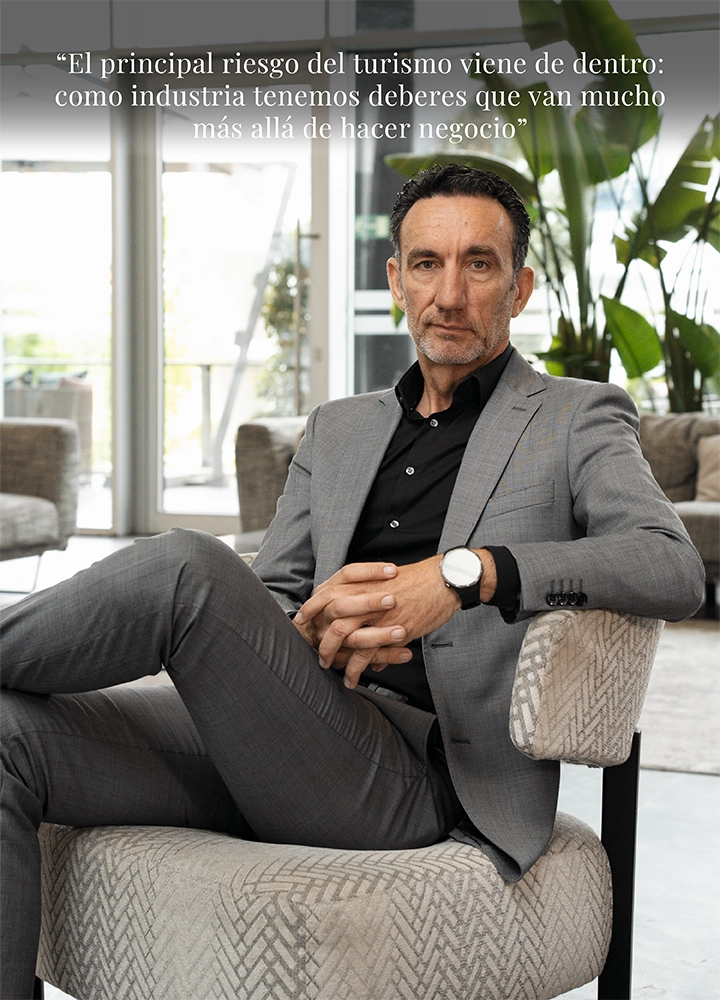
That is why I believe the main risk comes from within. As an industry, we have duties that go far beyond doing business: caring for the sector’s reputation, taking care of people, territories, and the environment. All of that is in our hands and, little by little, it is happening, but not at the speed or with the intensity that an industry like tourism demands. The more it grows, the more important it is to resolve those internal challenges.
And what about specific risks for specialized media like Hosteltur?
The underlying problem is that there is no real independence for the media. Staying informed today requires an enormous amount of work: to have a more or less informed opinion on something, you have to read four newspapers. It shouldn’t be that way.
We try to protect ourselves by diversifying our income as much as possible and, above all, through responsibility and complicity with the sector. When we publish something that is not beneficial to a company, we want them to know that we are not doing it to damage the brand. It is a matter of consistency, of credibility. If we were to sell ourselves to a large group that dictated our editorial line, we would be dead.
You are known for your respect and affection for animals and nature. What have they taught you?
Animals and plants have taught me to have patience. But having patience does not mean having time, and therein lies the problem: the planet, its resources, and animals do not have time.
I am an optimist by nature, but on this issue, the balance comes out negative for me. We are driving species to extinction that we will never see again. The story of the lynx in Spain is impressive and shows that things can be done, but while we were saving the lynx, during that same time we have extinguished many other species—some that we never even got to know.
To close: what would you ask of the world, your own “impossible”?
For there to be more generosity. I believe that as we age, we all tend to close ourselves off a bit, and we should make it our goal to be more generous with others. It is a noble gesture that, furthermore, usually comes back to you.
It can be applied to everything: to your children, your partner, with your friends, at work. More generosity in all our environments.