Scale of the Problem
Food waste is a problem that creates a dual impact: environmental and social. According to the UNEP (United Nations Environment Programme) “Food Waste Index Report 2021,” food waste generates 10% of global CO2 emissions—almost double the emissions produced by all cars driving across the United States and Europe in an entire year. But it is also a major social issue, as this volume of waste could feed the entire global population until 2050 and nourish the 800 million people who go hungry every day up to seven times over.
This issue directly concerns us because it aligns with Target 12.3 of Sustainable Development Goal (SDG) 12: Responsible Consumption and Production. Target 12.3 aims to halve per capita global food waste at the retail and consumer levels and reduce food losses along production and supply chains.
ILUNION Hotels’ Strategy Against Food Waste
The company’s Sustainability Master Plan includes among its core goals the prevention and management of any negative environmental impact generated by our operations. Furthermore, ILUNION Hotels is committed to society’s most vulnerable groups; thus, the challenge of food waste requires a dedicated policy and procedure to fulfill this commitment.
In the hotel sector, the most common causes of food waste are typically related to gaps in planning, purchasing management, handling, storage conditions, and employee and guest behavior. Therefore, our strategy analyzes and optimizes all processes through prevention and management to save food whenever possible. To achieve this, we prioritize the hierarchy of use established by international organizations such as the FAO, which places human consumption as the first priority. Secondarily, we evaluate alternative uses such as composting for agricultural purposes or animal feed.
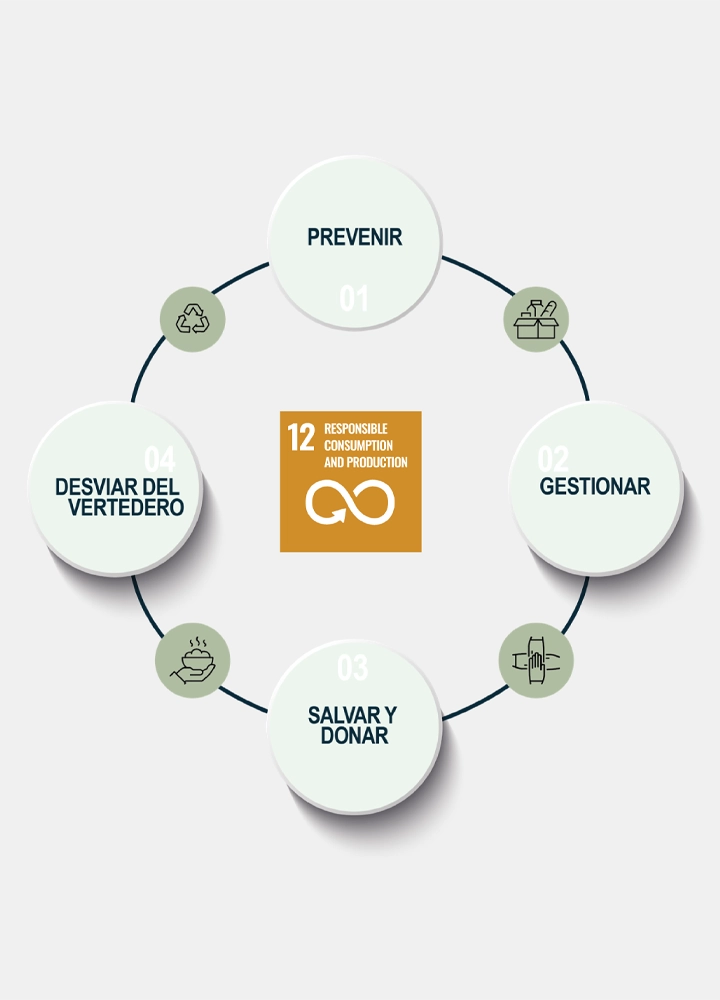
Strategy Phases
Prevent
The first step is the prevention of food waste across all our hotels. This fundamental process centers on three key areas: planning, purchasing, and storage.
Manage
Fully optimize food management to minimize waste as much as possible.
Save and Donate
Endeavor to save all surplus food generated throughout the hotels’ dining operations.
Offer guests leftovers from their orders in the cafeteria, at events, or from daily set menus, packing them in the company’s sustainable takeaway containers.
1. Maximize all surpluses that can be managed through Too Good To Go as key allies in the company’s food waste strategy (breakfast packs and event surplus).
2. Donate any food surplus that is not managed through the partnership with Too Good To Go to employees and social entities.
Divert from Landfill
Endeavor to transform unconsumed food suitable for non-human use into secondary products, keeping it from becoming waste.
Proper and rigorous segregation of organic waste.
Utilization of leftovers for animal feed production or composting for agricultural fertilizer.